
Searching Jackson County Civil Dockets
Most people begin at Kansas Judicial Branch CaseSearch. Pick the Jackson County or district-court context if the live form offers that filter. A search term is required. The portal may add filters for court, search type, case type, birth date, and filing date. The controls change over time, so follow the labels on the live form rather than an old menu.
A complete case number works best. Jackson County joined the Kansas eCourt system on July 11, 2022. Older files carry a legacy pattern of year, type, and six digits. Newer cases use an Odyssey format. It has a county prefix, a four-digit year, type, and six digits. Never guess the Jackson prefix. Copy the format from an official result or ask the clerk.
- Open CaseSearch and select the relevant court or county when that choice appears.
- Enter the full case number, preserving hyphens and leading zeroes.
- If the number is unknown, search a party or business name and narrow by filing date and civil type.
- Complete the human check, open the result, and confirm the county before reading events.
- Take the number to the courthouse terminal or clerk when a public item is not remote.
Jackson Civil Filings Snapshot
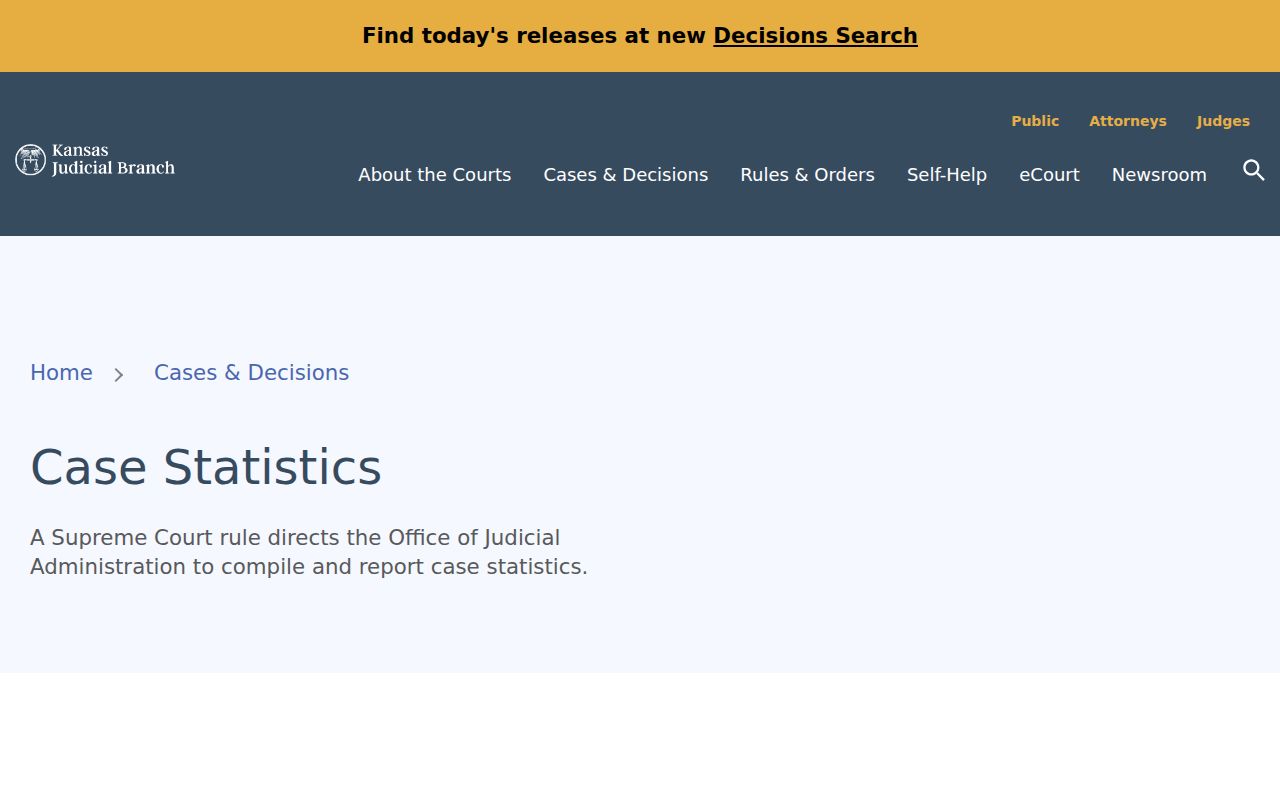
Kansas court statistics counted 419 Jackson County civil filings in fiscal year 2024. That was up from 401 in fiscal year 2023. Those are filing counts, not a tally of open cases or of distinct people. One case can generate many later docket events. For the full annual tables, see the statewide court statistics index.
That official index is where the civil-statistics figures come from. View the Kansas case-statistics source for the published tables.
Each fiscal-year report carries a Jackson row with the county totals.
Inside a Jackson County Civil Docket
Think of a civil register of action as an event index. It shows when a filing reached the court. It also shows what type of event followed, and whether an order or disposition was entered. It does not make every attached document public. Party labels shift with the matter, too. Petitioner and respondent can replace plaintiff and defendant.
| Case identity | Case number, filing date, Jackson County court, and civil category. |
|---|---|
| Participants | Public party roles, counsel and side, plus the assigned judge. |
| Events | Filings, service or notice entries, motions, settings, and orders when public. |
| Financial fields | Amounts or judgment data only when the public record displays them. |
| Outcome | Judgment, dismissal, disposition, or appeal and related-case indicators. |
Watch the verbs and event dates. A complaint states a claim; an answer responds; a motion merely asks the court to act. Only an order or judgment shows what the court decided. Settlement or dismissal entries may leave private terms undisclosed.
Jackson Limited-Action Docket Labels
Limited action gets its own label in Jackson County. The fiscal year 2024 table lists 297 limited actions. Of those, 295 were limited contract filings. That is a big share, but do not flatten it into "all lawsuits." It is also unsafe to treat every limited action as a small claim. Kansas uses limited action as a filing and jurisdiction category.
Portal wording may differ from the annual report column. Match the case type on the official result. Also check Kansas Supreme Court Rule 106B for which index fields can appear. Statistics measure workload. The individual docket tells the story of one case.
Civil Case Types on the Docket
The Kansas District Court holds general civil jurisdiction in Jackson County, and its civil workload reaches beyond standard contract suits. Annual statistics split out regular actions, limited actions, small claims, probate matters, and domestic relations. The case-type field keeps a searcher from joining records that simply share a name.
- Contract, tort, real-property, and other regular civil actions
- Limited actions, including the reported limited contract group
- Small-claims filings tracked as their own statistical class
- Probate and estate matters, subject to record-level access rules
- Domestic-relations matters, with added privacy concerns
City code disputes can start in a municipal court instead. A Holton municipal matter will not appear if you treat it as a Jackson County District Court civil case. When the issue arises only under a city ordinance, begin with the municipal clerk.
Jackson New-Filing Window
Kansas New Civil Filings is a separate, time-sensitive route for recently submitted civil documents. Annual-report material from the courts says a submission appears there once sent, unless sealed. It stays for three days unless rejected under Rule 23(c). The service is not a lasting Jackson County civil docket archive.
That distinct entry point is what the official page documents. Open the official Kansas New Civil Filings source to see it directly.
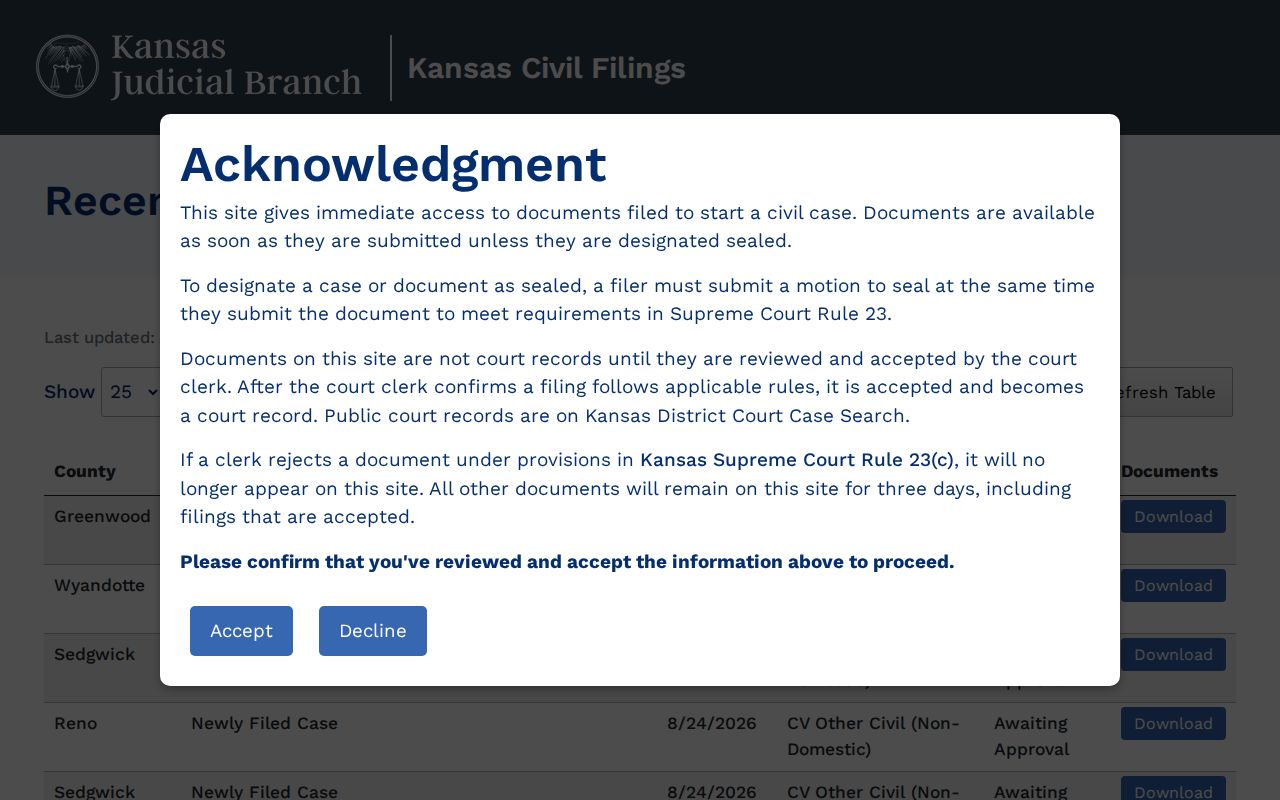
Anything visible there is still pre-review. Seeing a document does not prove clerk acceptance, a complete case file, or any final result. Turn to CaseSearch for the public historical case trail, and to the clerk for the official record.
Jackson Civil Docket Settings
A setting is a scheduled court event, not a disposition. The register may name a status hearing, motion hearing, pretrial event, or trial date. Write down the listed date, time, court, judge, setting type, and status. Then confirm any near-term appearance. Use the official calendar or the Clerk of the District Court.
A reset stays in the event history. It does not erase the prior date, dismiss the claim, or reveal why the schedule changed. For hearing dates in particular, use the Jackson County Court Dates resource. Compare the calendar entry with the case docket.
Older Jackson Civil Dockets
Why does a Jackson County civil docket search come up empty for an older case? The eCourt transition is the usual answer. Newer filings carry Odyssey-style numbers and broader online document coverage. Older Jackson County civil files, though, may still live partly or entirely on paper. So a blank remote result does not mean no public file exists.
Work every channel instead. Start with CaseSearch. Then try the public-access terminal. It sits on the third floor of the Jackson County Courthouse at 400 New York Avenue in Holton. Call the district clerk at (785) 364-2191. Ask whether a request may go by mail, fax at (785) 364-3804, or verified email. District Court hours are 8:00 a.m. to 4:00 p.m. on weekdays. Before you travel, confirm access, payment, and file availability.
Civil Docket Access Rules
Public access does not mean everything is open from home. Family, protection-order, juvenile, adoption, sealed, and other sensitive material can be redacted or restricted. A case number alone does not unlock every filing. The courthouse terminal may show more public data than the remote portal. Neither route overrides a statute, rule, or court order.
Key Kansas rules:
Kansas Supreme Court Rule 22 sets the court-record access framework and recognizes remote and courthouse access levels.
Kansas Supreme Court Rule 106B describes public case information and the events index.
K.S.A. 45-220 permits a written request and lets the custodian seek enough detail to locate the record.
Ask for the public portion of a court record, not access around a restriction. If access is denied or delayed, request the basis in writing. Remember that the portal is only a convenience copy; the originating court record controls.
Jackson Civil Docket Copies
Need a filed document, plain copy, or certified copy? The local source is the Clerk of the District Court. Give the case number, the exact filing or order, and your preferred form. Ask whether inspection at the public terminal will do. Staff may need to pull an older paper file. Ask about the current copy charge, certification charge, payment method, and delivery options too. Do this before sending any funds.
Jackson County posts no fixed civil copy fee schedule, so quoting a price here would mislead. Kansas law can allow reasonable charges and advance payment. A clear written request may go to the Clerk of the District Court, Jackson County Courthouse, 400 New York Avenue, Holton, KS 66436. Verify the clerk's published email too, since Kansas court web properties have moved to government domains.