
Searching Jackson County Criminal Dockets
Start with the Kansas Judicial Branch CaseSearch. Pick Jackson County when the option appears. A full case number works best as your key. Lacking one, try the public name search and filter by criminal case type and filing date. Expect the live interface to ask for the court, search type, search term, case type, date range, and a human check.
- Try the exact case number with hyphens and leading zeroes.
- For an older matter, try the legacy year, type, and six-digit pattern.
- For a newer matter, copy the county-prefix number from an official record.
- Check county, filing date, judge, and case type before accepting a match.
- Ask the clerk about the terminal when a public document is not linked.
Jackson County moved onto statewide eCourt on July 11, 2022. Records older than that switch may carry a different number form and include paper material. The county's case-number prefix is not something to guess.
Jackson Criminal Filing Snapshot
Official fiscal-year reports add context without exposing private names. Treat them as workload figures only, never as a live count or part of a conviction rate.
One report puts 15.9 percent of pending felonies and 8.8 percent of pending misdemeanors past the twelve-month mark. Pending is not the same as filed that year. The count also sweeps in unresolved cases that began earlier.
Inside a Jackson County Criminal Docket
The Kansas register of action is a procedural index, nothing more. Its header and event list hold useful facts about a court docket. Just remember that an entry label does not equal the filed order.
| Identity | Court, county, number, filing date, case type, status. |
|---|---|
| Roles | Judge, counsel, prosecution and defense roles where public. |
| Charge | Offense label, count, felony or misdemeanor level if shown. |
| Settings | Arraignment, preliminary hearing, motion, pretrial, trial, sentencing. |
| Outcome | Plea, dismissal, diversion, verdict, judgment, sentence, appeal. |
| Limits | Document links and restriction notices allowed for display. |
A charge is only an accusation. A trial setting does not prove a trial ever happened, so read forward to the disposition and pull the actual order when the exact language matters.
Jackson Criminal Outcomes in Context
The fiscal-year 2025 report counts 300 Jackson felony dispositions. Those break down as 204 guilty pleas, 55 dismissals, 10 deferred or diversion outcomes, 21 other dispositions, nine jury trials, and one court trial. For misdemeanors it lists 318 dispositions: 145 guilty pleas, 46 dismissals, 80 deferred or diversion outcomes, 35 other dispositions, and 12 court trials.
Those totals show why the complaint is never the ending. Dismissal, plea, diversion, trial result, and sentence are separate steps. Aggregate figures describe workload. The official entry and order alone describe one case.
How a Criminal Case Moves
Intake creates the case number and charge classification. From there the register may show appearance, counsel, bond, motions, pretrial dates, plea or trial, disposition, sentence, and later compliance events. Not every criminal docket uses each stage.
Docket flow: Filing › Arraignment › Pretrial › Plea or Trial › Disposition › Sentencing
Keep four dates distinct: filing, scheduled, actual event, and order. A reset does not erase the old setting, and a preliminary hearing is not a verdict.
Jackson District and Municipal Paths
State felony and misdemeanor filings go to the Jackson County District Court. The Clerk of the District Court keeps that record. Municipal courts are separate city courts handling ordinance violations under K.S.A. 12-4104.
| Matter | Court | Route |
|---|---|---|
| State crime | Jackson County District Court | CaseSearch, terminal, district clerk |
| City ordinance | Municipal court | City court clerk or city hall |
| Municipal appeal | May reach district court | Check both clerks and both numbers |
Federal charges belong to the District of Kansas and PACER. Choosing the wrong court level is a common reason a docket search comes back blank.
Courthouse Access for Jackson Dockets
CaseSearch is a convenience layer, not the official record. Rule 22 recognizes both remote and courthouse-terminal access. A terminal may show a broader public level. A document can still require a request. You will find the courthouse at 400 New York Avenue, Holton, KS 66436. The clerk's phone is (785) 364-2191. Listed office hours run 8:00 a.m. to 4:00 p.m. Monday through Friday.
Call ahead for an old file, a missing document, or a certified disposition. Any request should state the case number, item, date, court, and delivery method. Ask about current copy and certification charges too. No itemized local fee is published.
Courts That Hold Criminal Dockets
Jackson state criminal dockets live with the Kansas District Court. That court sits inside the Second Judicial District. The assigned judge appears in the current case header, not on any district-wide roster. An appeal carries its own appellate number. It follows the Kansas Court of Appeals route unless law sends it straight to the Kansas Supreme Court.
A district entry may note an appeal. That entry is not the appellate docket. A municipal judgment can later create a district matter under K.S.A. 22-3609. When a case moves, keep both case numbers.
Expungement and Jackson Search Gaps
A blank result does not prove no case exists. The cause may be the wrong court. It may be legacy numbering, incomplete digitization, a spelling slip, or a legal restriction. Juvenile, grand-jury, expunged, sealed, and certain investigation material can all sit outside public access. The official K.S.A. 22-2410 page states the special limits that apply to an expunged arrest record, and the assigned image records that official source.
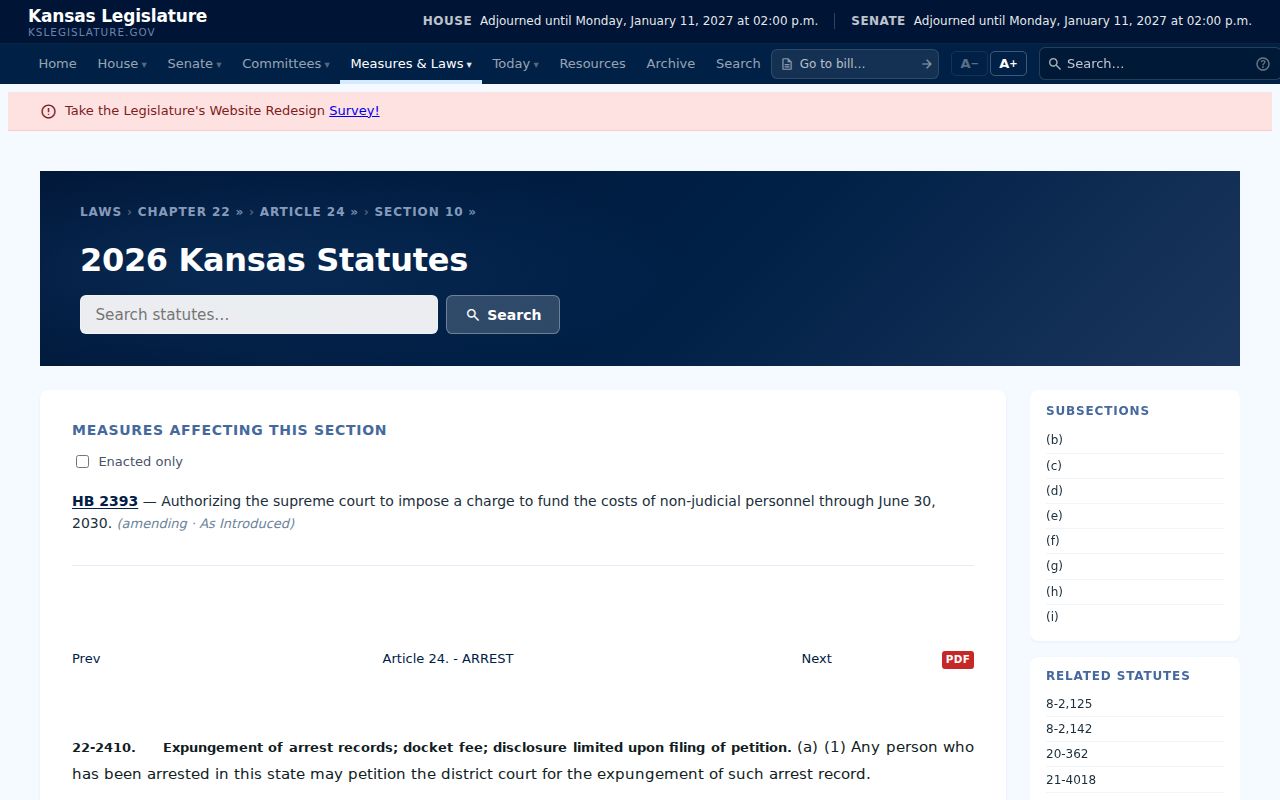
That statute explains why an expunged entry must never be rebuilt from stale mentions. When a restriction or blank return appears, take the question to the clerk rather than speculating.
Sealed Dockets and Public Access
Rules 22 and 106B draw lines between the public events index, remote access, terminal access, and the full file. Reaching one layer does not open every document. No terminal can override a sealing order or confidentiality law.
Verify the official layer. Use the portal for a lead, the terminal for the broader public view, and the clerk or certified copy for the official record.
K.S.A. 45-218 supplies the general open-records route, K.S.A. 45-220 permits a clear written request, and K.S.A. 45-221 lists the exceptions. Court rules still govern judicial records. Ask for any releasable portion plus the authority relied on for whatever is withheld.
Jackson Criminal Docket Verification
Check more than one field when you review a Jackson County criminal docket. Start with the court and the full case number. Then weigh the filing year, the case type, the judge, and the status. Check them against each other. A filing date and a hearing date are two different things. If the docket shows a setting but no outcome after it, leave the gap alone. Pull the register again. Try the public terminal. Ask the Clerk of the District Court whether a later public order exists.
Save the source URL and the time you pulled it. Online court records shift after a reset, a correction, a disposition, or an appeal. For something official, ask the clerk for a certified register or disposition. Name the exact document. The clerk can walk you through its format, the current charge, payment, and delivery. That matters for older Jackson files. Their event history crosses the July 2022 eCourt transition.
Think of CaseSearch, the courthouse terminal, and a clerk-issued copy as three separate layers. The portal finds public case information. The terminal can open up more public material than the portal shows. A certified copy authenticates the court record itself. Use each layer for its own job. A bare charge, an old setting, or a thin online return never gets repeated as a final outcome.
Jackson Criminal Docket Verification
For a final check, line up the key fields. Match the case number, the defendant name, the court, the charge level, and the newest event. Jackson County's annual disposition totals describe aggregate work. They say nothing about what happened in any named case. Does an event label confuse you? Ask the district clerk for the public order or judgment. A short portal label never controls; the filed paper does. Later entries can amend an earlier setting or disposition. Read through the end of the register before you lean on one line.